Geography
Meet our Geography Lead

Hi to all my fellow geographers! I'm Mrs Nnebi, the Geography Lead here at Joseph Turner. I have a genuine passion for teaching Geography, and I am committed to helping our pupils understand the world around them - its landscapes, cultures and the challenges we all share.
My favourite place to visit has to be Morocco because I love its vibrant culture, beautiful landscapes, and the special memories I’ve made there. It’s a place that makes me feel inspired, relaxed, and completely myself.
Through engaging lessons and hands-on learning, I strive to inspire curiosity, critical thinking, and a love of exploration in every learner.
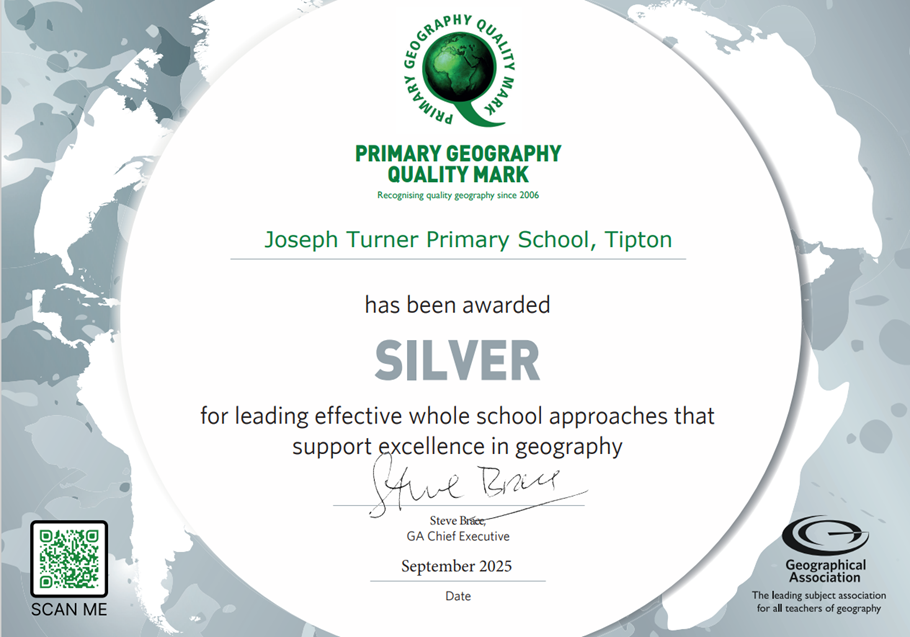
In my second year here, I was proud to achieve the Primary Geography Quality Mark (PGQM), earning a Silver Award in 2024 — an accomplishment made possible thanks to our amazing pupils and dedicated staff. This achievement reflects our commitment to delivering high‑quality Geography provision and creating engaging, meaningful learning experiences for all of our pupils.
Vision:
At Joseph Turner Primary School, our Geography curriculum is designed to inspire in pupils a fascination and curiosity about the world and its people that will remain with them for the rest of their lives. At Joseph Turner, we nurture independent, confident and aspirational learners who enjoy and love learning about geography, not only through experience in the classroom but also through fieldwork and educational visits. Our teaching intends to equip pupils with knowledge about the wider world while also helping them understand and appreciate their local area of Tipton. As a town shaped by its rich industrial past, diverse community, and evolving landscape, Tipton gives our pupils a real-life context for learning about human and physical geography. From exploring the legacy of the canals and the Black Country’s industrial heritage to observing how the local environment continues to change, pupils develop a strong sense of place and pride in their community.
Implementation - What is taught and how is it taught?
At Joseph Turner Primary School, we pride ourselves on the consistent approach to teaching and learning that can be observed across all phases of school. This is achieved through our commitment to quality first teaching on a daily basis. Expectations of staff and pupils are high resulting in good progress in all phases. There is a universal understanding of what outstanding teaching, learning and assessment should entail. These strategies are consistently used throughout school and it is the expectation of leadership that all lessons will include a variety of these to enable all learners to reach their full potential. Active learning is essential in all aspects of the lesson. All staff use the same terminology so learners develop a knowledge and understanding of the different ways they learn. At Joseph Turner, we believe outstanding teaching, learning and assessment must include:
1. Challenge for all
2. Collaborative learning
3. Assessment for learning
4. Questioning
5. Progression within lessons and books
6. Learning behaviours
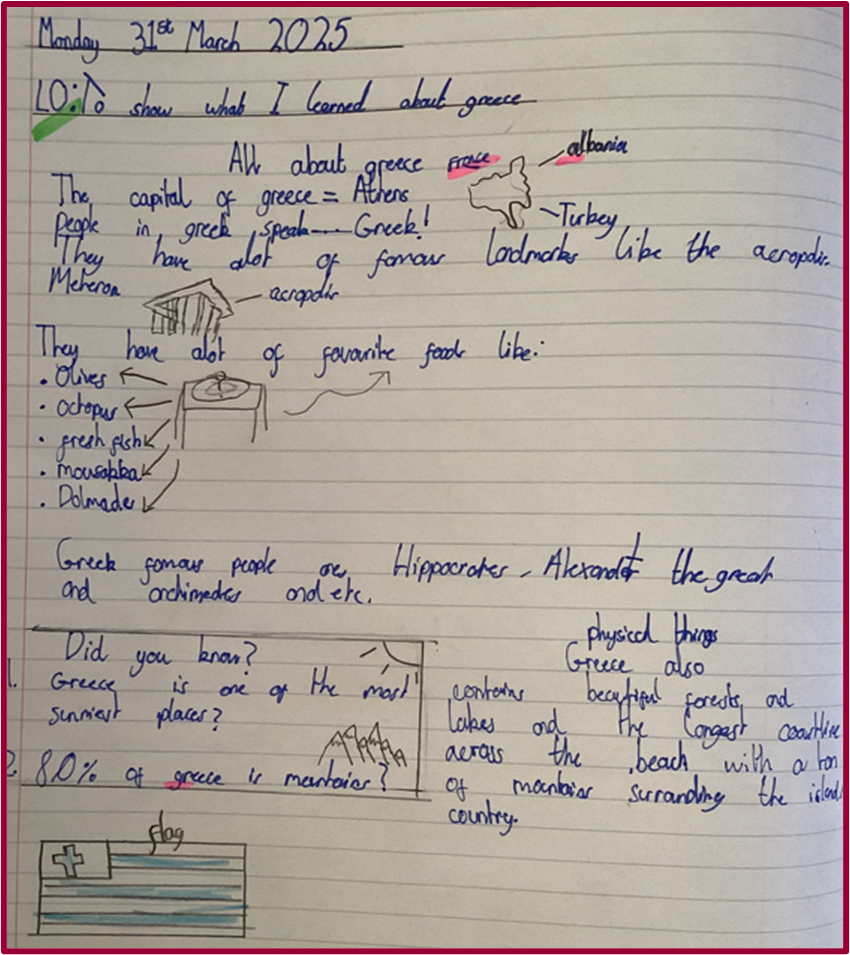
We are working hard to promote our pupils’ literacy , pupils are encouraged to communicate and read widely and often in Geography. At Joseph Turner, we implement a thematic curriculum that ensures the high-quality teaching and learning of geography through termly themes. By the end of their primary education, our pupils will have:
- a contextual understanding of the location of globally significant places- both terrestrial and marine- including defining their physical and human characteristics and how these provide a geographical context for understanding the actions of processes
- understand the processes that give rise to key physical and human geographical features of the world, how these are independent and bring about spatial variation and change over time
We use the Geography National Curriculum Programme of Study to inform our curriculum and to guide us on the focus and content of each objective. Cross-curricular learning enriches the topic where appropriate.
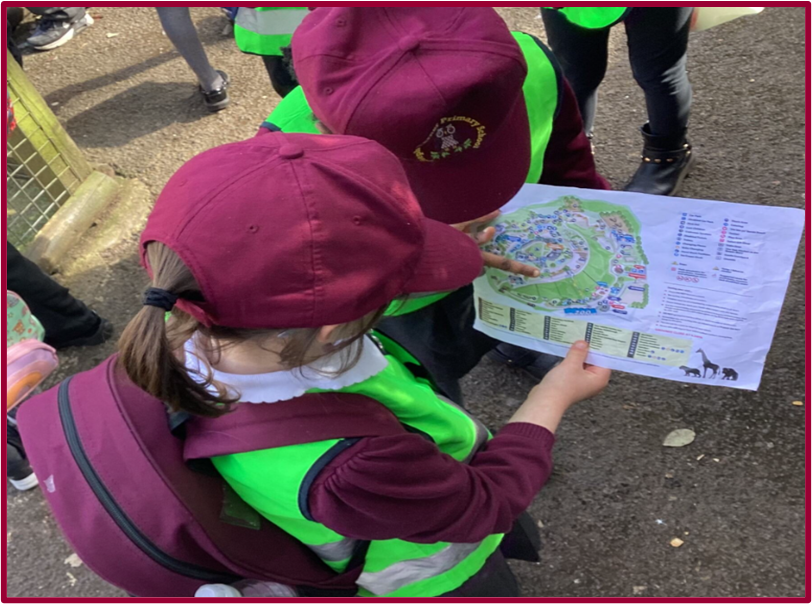
In the Early Years Foundation Stage, geography learning is developed within the ‘Natural Word' and People, Culture and Communities' ares of the Development Matters Framework. In Key Stage One and Key Stage Two, geography is taught as part of a termly topic, focusing on the knowledge and skills stated in the National Curriculum. At Joseph Turner, we understand the importance of allowing children to gain ‘real-life’ experiences and the theme for the term is usually accompanied by a ‘hook’ or visit, to provide the children with first-hand experiences to support and develop their knowledge and understanding.
Within EYFS, children will be taught to:-
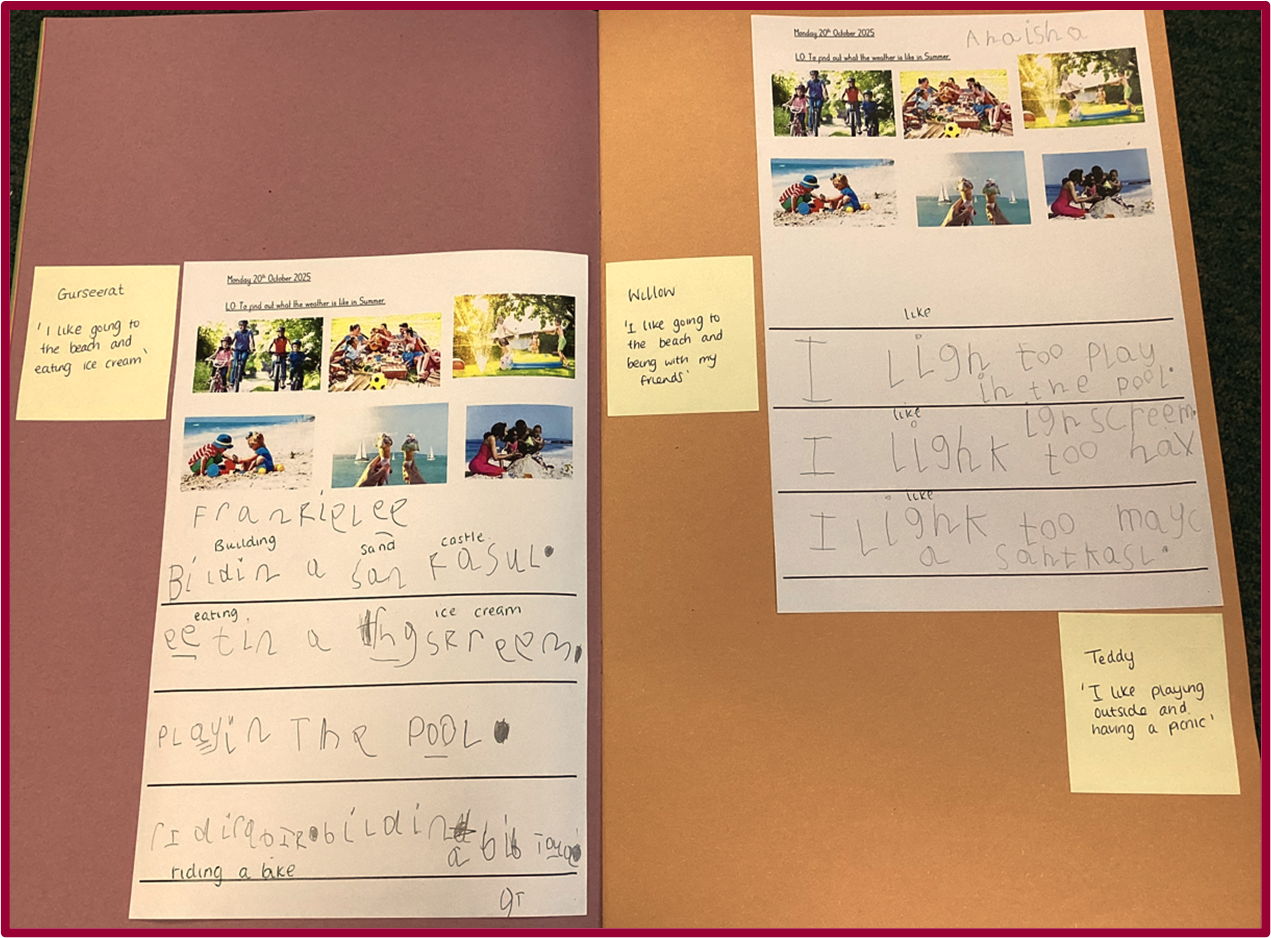
- explore the natural world around them, drawing on observations and drawing pictures of animals and plants.
- know some similarities and differences between the natural world around them and contrasting environments, drawing on their experiences and what has been read in class.
- understand some important processes and changes in the natural world around them, including the seasons and changing states of matter.
- describe their immediate environment using knowledge from observations, discussions, stories, non-fiction texts and maps.
- know some similarities and differences between different religions and cultural communities in this country, drawing on their experiences nd what has been read in class.
- explain some similairities and differences between life in this country and life in other countries.
In Key Stage One, the children will be taught:-
Locational knowledge
- name and locate the world’s seven continents and five oceans
- name, locate and identify characteristics of the four countries and capital cities of the United Kingdom and its surrounding seas
Place knowledge
- understand geographical similarities and differences through studying the human and physical geography of a small area of the United Kingdom, and of a small area in a contrasting non-European country
Human and physical geography
- identify seasonal and daily weather patterns in the United Kingdom and the location of hot and cold areas of the world in relation to the Equator and the North and South Poles
- use basic geographical vocabulary to refer to:
- key physical features, including: beach, cliff, coast, forest, hill, mountain, sea, ocean, river, soil, valley, vegetation, season and weather
- key human features, including: city, town, village, factory, farm, house, office, port, harbour and shop
Geographical skills and fieldwork
- use world maps, atlases and globes to identify the United Kingdom and its countries, as well as the countries, continents and oceans studied at this key stage
- use simple compass directions (North, South, East and West) and locational and directional language [for example, near and far; left and right], to describe the location of features and routes on a map Geography
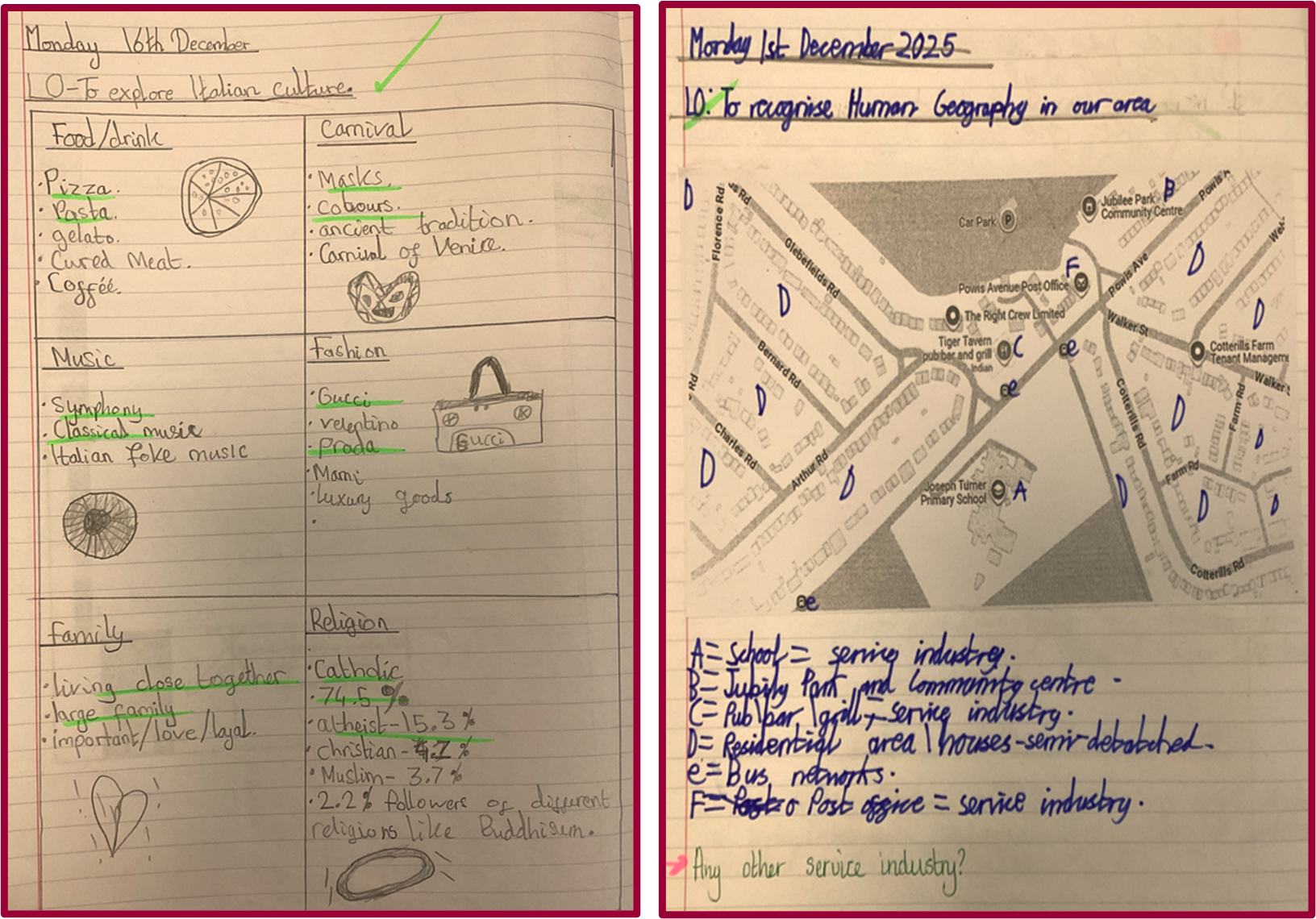
- use aerial photographs and plan perspectives to recognise landmarks and basic human and physical features; devise a simple map; and use and construct basic symbols in a key
- use simple fieldwork and observational skills to study the geography of their school and its grounds and the key human and physical features of its surrounding environment.
In Key Stage Two, the children will be taught to:-
Locational knowledge
- locate the world’s countries, using maps to focus on Europe (including the location of Russia) and North and South America, concentrating on their environmental regions, key physical and human characteristics, countries, and major cities
- name and locate counties and cities of the United Kingdom, geographical regions and their identifying human and physical characteristics, key topographical features (including hills, mountains, coasts and rivers), and land-use patterns; and understand how some of these aspects have changed over time
- identify the position and significance of latitude, longitude, Equator, Northern Hemisphere, Southern Hemisphere, the Tropics of Cancer and Capricorn, Arctic and Antarctic Circle, the Prime/Greenwich Meridian and time zones (including day and night)
Place knowledge
- understand geographical similarities and differences through the study of human and physical geography of a region of the United Kingdom, a region in a European country, and a region within North or South America
Human and physical geography
- describe and understand key aspects of:
- physical geography, including: climate zones, biomes and vegetation belts, rivers, mountains, volcanoes and earthquakes, and the water cycle
- human geography, including: types of settlement and land use, economic activity including trade links, and the distribution of natural resources including energy, food, minerals and water
Cultural Capital
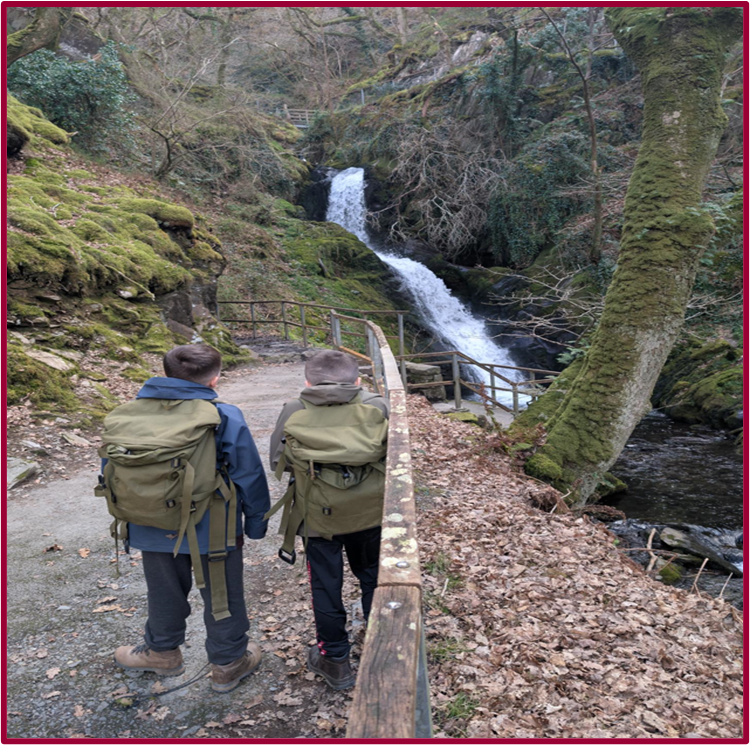
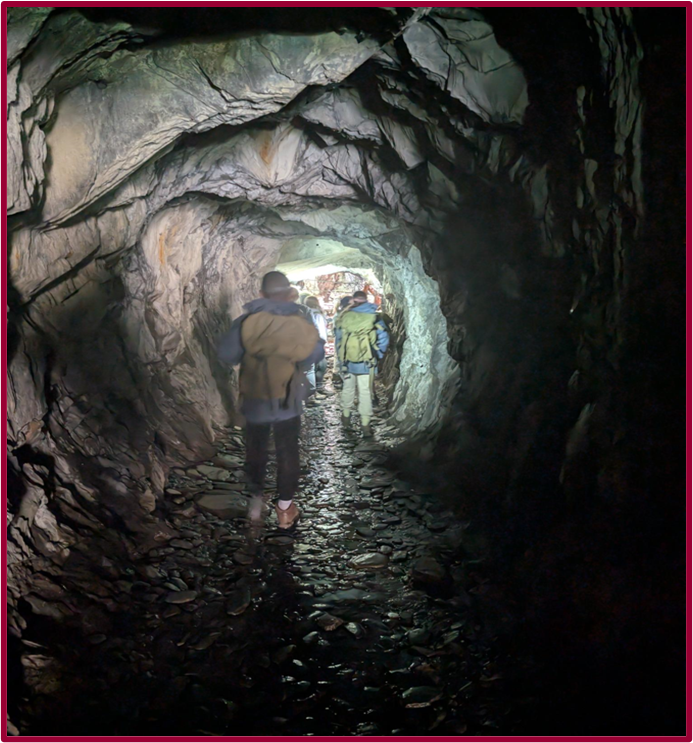
At Joseph Turner Primary School, children benefit from a flexible curriculum that builds on what they understand and know already. We believe that exposure, not only to culture but also to situtations in which the children might not have previous experiences of, is of paramount importance to their ongoing successes. Geography is a topic that lends itself well to developing cultural capital. Within Geography, we develop cultural capital by delivering knowledge and making educated citizens who learn from the events, people, ideas we study. We aim to provide at least one high quality geographical trip or visitor for each year group throughout the year for our pupils to gain a wider context to their unit of study. We provide field work opportunities for children to explore their local area and also areas further within the UK, providing child a ‘concrete’ experience and an opportunity to bring their learning to life. Carefully sequenced geographical vocabulary ensures that our children move up through our school with a vocabulary basis that can be applied to a new topic and support their geographical understanding.
Impact:
Our Geography curriculum inspires curiosity, deepens children’s understanding of the world, and equips them with the knowledge and skills needed to become thoughtful global citizens. By the end of their primary journey, our teaching intends to equip pupils with knowledge about:
- diverse places and people;
- resources and natural and human environments;
- a deep understanding of the Earth’s key physical and human processes and
- the formation and use of landscapes and environments.
Our high-quality geography curriculum also aims to provide children with necessary geographical skills:
- collecting and analysing data;
- using maps, globes, aerial photographs and digital mapping to name and
- identify countries, continents and oceans and
- the ability to communicate information in a variety of ways, including through maps, numerical and quantitative skills and writing at length.
Through carefully sequenced learning, children build strong locational knowledge, confidently use maps and fieldwork skills, and apply geographical vocabulary with accuracy. They become increasingly analytical, able to ask questions, draw conclusions, and present their findings in a range of ways. Fieldwork opportunities allow pupils to experience geography first‑hand, fostering a sense of responsibility for their environment and a desire to care for the planet.
As a result of our curriculum, pupils leave primary school with a broad, balanced, and secure geographical understanding. They are curious, informed, and empowered learners—ready to explore, protect, and contribute positively to the ever‑changing world they live in.
Geography Skills Progression
Geographical Vocabulary Overview
Geography Long Term Overview
- Geography Topic Overview.pdf
-
Geography in Action
-